Today's photographer is one of those professional photographers that I always make the time to look at her images when she posts them... and I love when she travels... we get to see images from some great locations as seen through Deb's eyes...
Today Deborah shares with us some of her photos from a recent trip to London... and as always, they are great... and inspiring...
Take it away Deborah
One of the fascinating
aspects of photography is the ability of the photographer to convey the passage
of time, or create a sense of motion through the art and technique of long
exposure. You can create beautiful long exposure images at the edge of night
and beyond, and capture surreal photos during the brightness of day. With the
use of neutral density filters, you can calm the crashing waves of an ocean,
softly blur clouds across the sky, and create the impression of emptiness on
busy walkways and streets. Everything changes, the reality, the mood, and the
drama of a composition, and allows you to create expressive, fine art
imagery.

For example, when I traveled to London
recently, everyone including me photographed iconic subjects such as the London
Eye. It’s a fascinating structure, and barely seems to move. With a little
creative effort and the use of a 10 stop neutral density filter, I was able to
create a sense of motion and convey the passage of time. The extended exposure
of 113 seconds gives the photo a creative edge over many travel pictures making
it more artistic. Long exposure photography requires more time, effort, and
patience, however it’s rewarding to come away with a unique and beautiful photograph
that is the result of an extended exposure.
 Here’s how you do it— To blur clouds and
water, and capture a subject in motion, you’ll need a sturdy tripod, cable, or
remote release, and a 10 stop neutral density filter such as the Lee Big
Stopper or Singh-Ray Mor-Slow. Much like using an infrared filter on the lens,
compose, meter and focus first. You can calculate exposure for the 10 stop
neutral density filter based on metered exposure using an app such as NDTimer
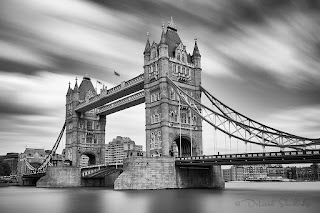
or Long-time. Ideally, something needs to be moving in the composition to create
a compelling long exposure image. The London Eye Ferris wheel or clouds moving
through the scene in the photo below of Tower Bridge in London make
eye-catching images. Ocean waves crashing over rocks can create a softened,
ethereal scene or rippled water in a lake can become magically smooth—your
opportunities are endless!
Here’s how you do it— To blur clouds and
water, and capture a subject in motion, you’ll need a sturdy tripod, cable, or
remote release, and a 10 stop neutral density filter such as the Lee Big
Stopper or Singh-Ray Mor-Slow. Much like using an infrared filter on the lens,
compose, meter and focus first. You can calculate exposure for the 10 stop
neutral density filter based on metered exposure using an app such as NDTimer
or Long-time. Ideally, something needs to be moving in the composition to create
a compelling long exposure image. The London Eye Ferris wheel or clouds moving
through the scene in the photo below of Tower Bridge in London make
eye-catching images. Ocean waves crashing over rocks can create a softened,
ethereal scene or rippled water in a lake can become magically smooth—your
opportunities are endless!
Thanks Deborah... to find Deborah on the web, please see the following links...


